
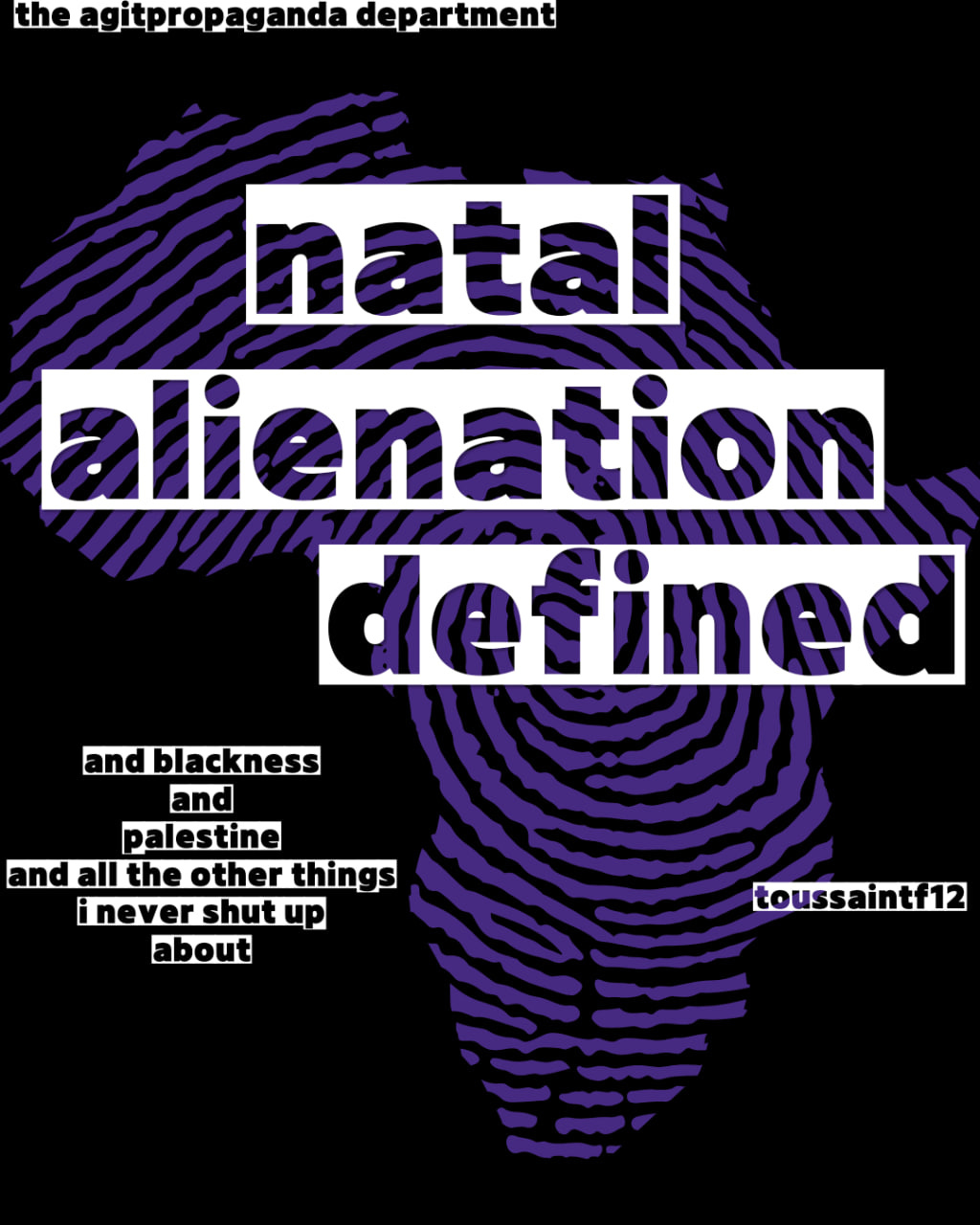
natal alienation: a definition

as i started getting deeper into black study, philosophy, existential writings, all that, readings that were helping me understand my own being, my own position in the world, i kept running into terms that sounded important before i really grasped what they meant. like u can tell the term is carrying some real shit, but it hasn’t landed yet. one of those terms for me was natal alienation. i probably glossed over it a few times before i decided to really break it down to grasp the full scope of what i was trying to understand.
like, genuinely. it sounded pretty abstract to me. one of those terms that gets said like everybody in the room is already supposed to know. and i hate that. i hate when language starts acting exclusive before it starts being useful. so i had to slow down and do the work of breaking the idea open, making it answer to my brain, making it answer to what i actually know and feel and see.
the phrase comes most directly from the sociologist orlando patterson, especially in his work on slavery. he uses natal alienation as part of a broader definition of slavery. later, people in black studies, especially those thinking thru slavery, social death, kinship, anti-blackness, and the afterlife of slavery, keep using the term because it names something foundational. so this is not just some random philosophical phrase floating in the air. it comes out of an effort to describe what slavery actually does. not just to labor. not just to the body. but to a person’s relation to origin, to family, to history, to continuity itself.
a precise definition is this:
natal alienation is the structural severing of a person or people from lineage, inheritance, and socially recognized belonging.
aight now let me break do my best to break it down.
continuity here means the ongoing thread that lets a person or a people remain connected to origin across time. continuity means u are not just dropped into the world as an isolated individual. it means your life is held in a line. u come from somewhere, u belong to someone, something is passed to u, and something can be passed on through u.
structural means this isn’t just personal pain, personal confusion, family drama, or some one-off tragedy. it means that this alienation is organized by a system. it’s reproduced thru law, force, property, state violence, displacement, captivity, and all the ordinary machinery of domination.
alienation here does not just mean feeling weird, disconnected, lonely, or existential in the casual sense. it means separation produced by a structure of power. it means being cut off from something that should have been part of u or available to u as a condition of being fully human in the world.
lineage means your line of descent. who u come from. who came before u. who comes after u. the chain of relation that tells u that your life belongs to something larger than just this moment.
inheritance doesn’t only mean money or property. that’s too narrow. inheritance can mean name, memory, story, language, land, ritual, relation, obligation, and history. all that. it means what gets passed down, and what u are supposed to be able to pass on.
socially recognized belonging means your ties to family, community, and origin are treated as real and protected. they count. they are not just sentimental. they arent fragile because some institution decided they could be broken whenever convenient. like going from african to slave to nigger to negro to african amerikkkan to who tf knows whatevers next.
now the basic definition is alot simpler.
natal alienation means your beginning isn’t guaranteed to u.
that’s really it. that’s the hard center of it. your beginning. where u come from. who u belong to. the line that should hold u in the world. natal alienation means that beginning can be interrupted, stolen, erased, renamed, displaced, fragmented, or made unstable by design.
so no, this is not just being estranged from your family. it’s not just not knowing your roots in some soft identity-crisis way. it’s not just missing home. it’s not just feeling disconnected. all those things may be real, but this is more than that. this is when a system makes your relation to origin fragile. when your belonging is exposed to just getting snatched from u. that’s why the term comes out of slavery.
under slavery, natal alienation was literal. people were torn from kin, from land, from language, from names, from social place. family ties could be broken at any moment. children could be sold. parents could be separated. whole lines of descent could be shattered because the point was not just to dominate labor, but to dominate relation. to make sure your ties to others existed only at the mercy of power. so slavery wasn’t just about being owned. it was about being cut off from the ordinary conditions that make a person continuous with a family, a history, a future.
when i’m using this term, i’m not using it like slavery is some old closed chapter and now we’re just borrowing a concept from the archive. hell nah. i’m using it in the context of the afterlife of slavery. meaning slavery didn’t end just because one legal form changed. the structure mutates and the philosophy survives. anti-blackness keeps reproducing that vulnerability. black life remains exposed to forces that tear at our continuity. prison. policing. eviction. foster systems. surveillance. medical abandonment. environmental poisoning. premature death. debt. displacement. school closures. state violence. all these things don’t just hurt individuals.they keep making our belonging vulnerable.
i mean that anti-blackness doesn’t just injure black people as isolated persons. it attacks memory and the possibility of secure belonging across generations. it makes all that shit normal. normalized means that people start acting like there’s nothing to explain, like this is just what happens to us. that’s part of the violence too.
so imagine a boy named malachi. his grandmother has photo albums stacked in a hall closet. his auntie knows the whole family tree and says names like she’s keeping people alive by saying them. the church down the block has funeral programs going back thirty years. the corner store owner remembers him as a baby. the old folks remember his father, and his father remembers his own father, and all of that gives him a sense, even if nobody say it out loud, that he comes from somewhere. that he is held.
now imagine how that gets torn apart. his father gets taken by the state and disappears into prison for most of his childhood. his mother gets pushed out of the neighborhood after rent goes up and wages don’t. the church closes. the school closes. the block gets swallowed by “development.” the photo albums get damaged during a move. the cemetery where his people are buried is neglected, fenced off, then threatened by construction. cousins get scattered across cities and counties. some end up in foster care. some end up dead. some end up under constant surveillance before they’re even grown.
malachi is still alive. he can still laugh, think, love, desire. but the web that was supposed to hold him in continuity keeps getting torn. what should feel like inheritance starts to feel like fragments. what should feel like belonging starts to feel provisional.
that is not exactly slavery. i’m not flattening the distinction. but it shows how natal alienation works as a logic in the present. the point is that the violence deosnt only target the body. it targets the material and social conditions that let a person say, “this is where i come from”, these are my people, this is what anchors me, and have that statement mean something in the world.
but when yuor beginning is not secure, that does something psychic to u!
sometimes people hear structural analysis and think it has nothing to do with inner life. like the structure is out there and the psyche is in here and the two never touch. but of course that’s bullshit. structure lands in the body. structure lands in feeling. structure lands in how u move thru the world.
if your beginning isnt secure, u dont move thru life with the confidence that your attachments will hold. belonging can start to feel a bit temporary. intimacy can feel haunted by disposability, and your memory can feel damaged before u even touch it. even love can start to carry panic in it, because u know how easily things get taken. there can be grief there, yes, but sometimes it’s like a low-grade disorientation. sometimes it’s numbness, or maybe it’s a constant improvisation of self, like u are always trying to build ground underneath your feet while standing on it. sometimes it’s the feeling that continuity itself belongs to other people, and u only ever get fragments.
this gives a language to a violence that isnt always immediately visible. people recognize spectacular loss. they recognize the obvious break. but natal alienation helps name the attack on us existetially. the attack on the conditions that let people stay tethered to one another across time.
this also helps me think about palestine, and as usual, i want to be careful and precise here.
i am not saying every structure of domination is the same. i am not saying palestinian dispossession is simply reducible to blackness. im not saying all suffering collapses into one grammar and we can just call it solidarity and move on. no. i’m saying there is a connection in the mechanisms, and that connection matters.
the israeli occupation, and the genocidal destruction of palestinian life, also attack continuity. not only people’s bodies, although its obviously that too. not only homes, though obviously that too. it attacks the conditions that let a people remain continuous with themselves. families are shattered. homes are leveled. schools, universities, hospitals, roads, mosques, churches, archives, water systems, olive groves, graveyards, entire neighborhoods are destroyed. thats not only the destruction of present life. its also an assault on inheritance, land, memory, kinship, and futurity. it is an assault on the material basis of belonging.
in that sense, natal alienation helps name what occupation is trying to do. it seeks to make origin unstable. it seeks to sever people from land, from kin, from the infrastructure that allows a people to say, “we are from here, we belong to one another, and we will continue”. occupation doesn’t just dominate the present. it tries to damage the future by destroying the line between past, present, and what comes next.
blackness is already positioned in a particular way here. and u know what i mean by that. so when i connect natal alienation to palestine, i’m not saying palestine “becomes” black. i’m saying the occupation uses a logic that becomes better understood when u look at how the “modern world” has long organized violence thru severance, dispossession, and the destruction of continuity, while blackness remains a singularly positioned site in that history. and fr thats pretty fucked up no matter how u look at it.
when i talk about blackness, i keep talking about palestine not because i’m trying to borrow urgency from somebody else’s suffering, and not because i want to put all these histories together into one easy slogan, but because this moment has made certain structures of domination visible in a way the world is actually willing to look at. people learned how to say occupation. siege. forced displacement. collective punishment. ethnic cleansing. genocide. people learned how to watch a people be starved, bombed, uprooted, and caged, and call that shit what it is. that same level of clarity, that same level of intensity, that same moral seriousness and reverence hasn’t been typically extended to black struggle in the same way, not with the same consistency, not with the same willingness to face what this world has done and is still doing. so when i bring palestine into conversation with blackness, i’m trying to use the opening that exists to draw the connection, sharpen the contradiction, and make our analysis more precise, more efficient, more dangerous to the lies that empire tells about itself and that we tell about each other. and yall know i cannot stand the shitty ass empire. palestinians havent occupied the exact same position as black people in the modern order, and i want to stay careful about that. the structures aren’t identical. but when i watch an occupation try to destroy a people’s continuity, their kinship, their land, their memory, their future, i know that playbook. i know what it means when power tries to make that shit regular, when it tries to sever a people from what holds them together and then call that security, or necessity, or war. and that recognition is the solidarity that says, “we have seen this machinery before, we have lived inside its consequences, and we are not going to stand by acting all confused while it tries to do to somebody else what empire has long practiced on us.”
and yeah, maybe i sound like a broken record bringing palestine up again and again, especially now that the volume has dropped, now that people aren’t speaking with the same urgency, the same outrage, the same public grief they had before. but fuck it. some things need to be repeated because repetition is part of struggle. i keep talking about palestine because i don’t want the slowing of attention to become permission, or for the world’s fatigue to harden into consent. i do not want the empire to keep doing what it always does, which is wait for people to move on, wait for horror to become background noise, wait for the unbearable to become ordinary. we cannot let that shit slide. we have to keep alive the memory of what empire is, how inhumane it is, how it feeds on dispossession, captivity, bombardment, and the destruction of whole peoples’ conditions of life. and for me, that memory is never just about what they are doing to palestinians now. it is also about what was done to us, what is still being done to us, the long evidence black life carries about what this world is willing to destroy and then justify. so yes, i’m going to keep saying it. i’m going to keep naming palestine when i name blackness, and blackness when i name palestine. because forgetting is one of empire’s favorite weapons, and i’m not interested in helping it.
.
.
.
.
Thank you for writing this. This is a must restack.
ive never heard anyone talk about continuity like this---going to keep returning to this for a while.
thank u as always 4 reaching into the deep ♡
and for ur repetition